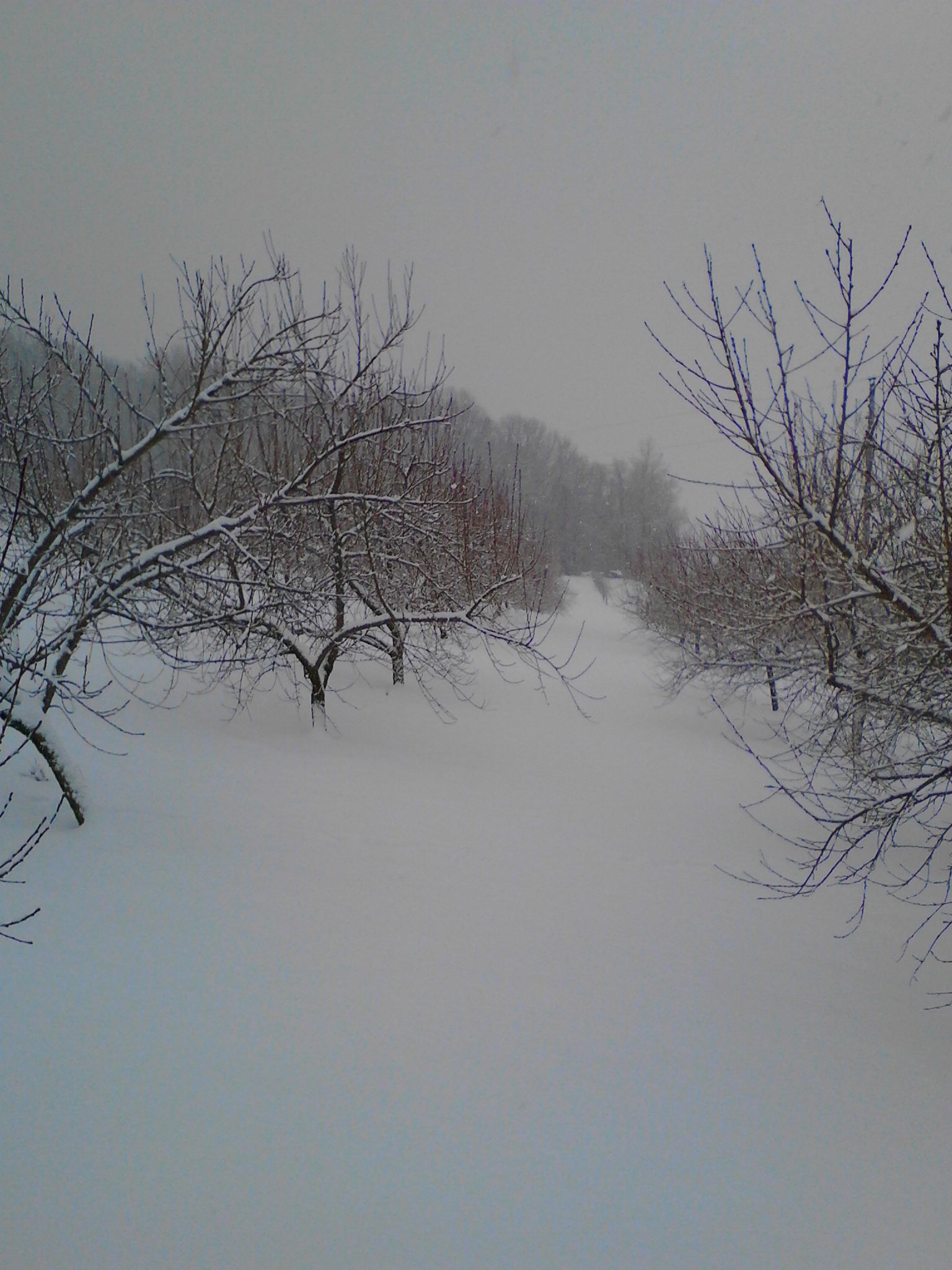
Pruning our Apple Orchard

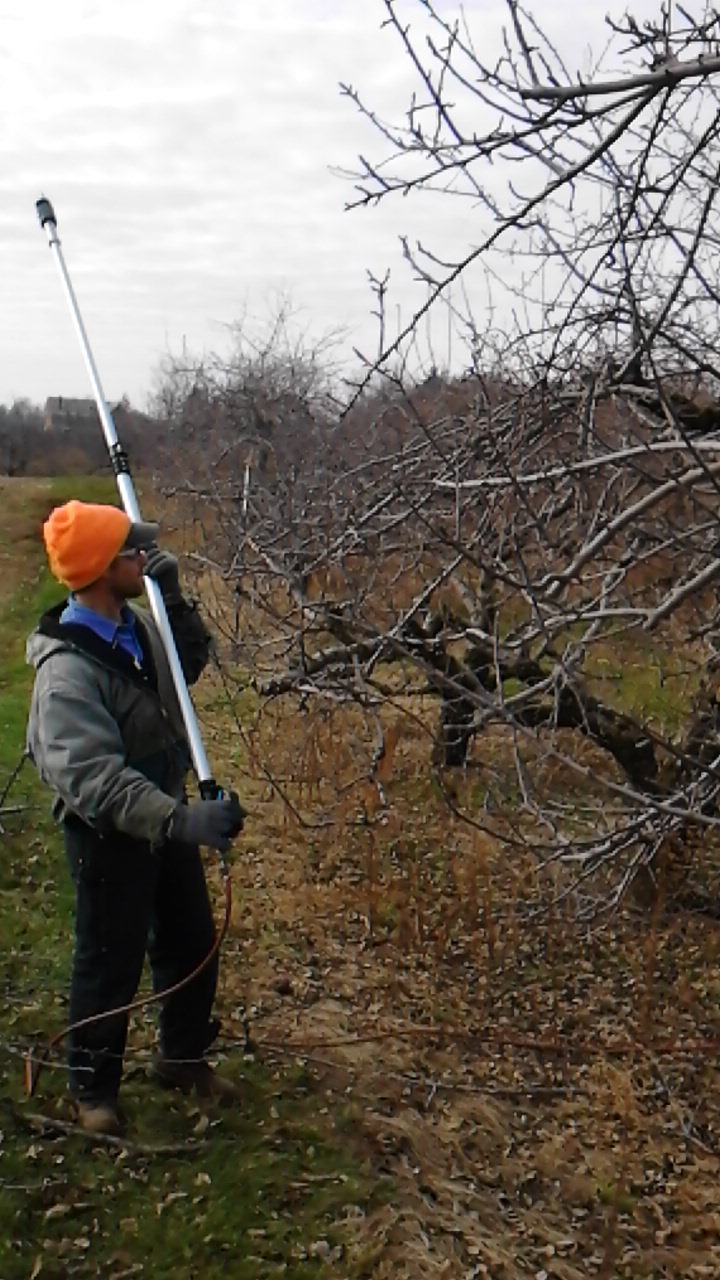
Orchard work is an all year long endeavor.  Holidays are over, trees are dormant and so out we go to start pruning. The moderately warm temperatures of late December provided us an opportune time to begin pruning in the apple orchards.  The ideal time to prune is when the trees have reached complete dormancy and temperatures are at or above freezing.  Most of the time for us this temperature range is not always feasible.  If temperatures are at 25degrees with no wind, you will find us donning insulated work clothes and taking the pruning  equipment out into the orchard.Pruning an apple tree

Why prune? Pruning is done during a tree’s productive years.  Pruning is indeed an art.  The process takes in analyzing the tree’s vigor and understanding the characteristics of each apple variety.  The decision to remove what branches from each tree is based upon how to establish fruit quality enhancement and how to stimulate tree vigor.  There is probably not a single pruning technique or method that is always perfect.  Each tree has its own unique characteristics and needs an individual touch.  Pruning is a continual learning process, putting into practice several basic concepts and rules.  Once you become familiar with tree growing habits and the basic pruning concepts you should be able to prune any tree with confidence.

Pruning fruit trees has several main purposes: control tree sizes, shape the tree properly and allow sunlight, air and spray to reach the fruit.  Just as we get haircuts to control and eliminate those “bad hair days,” we control the size of the tree with pruning.  Sizeable branches are removed to keep the trees from growing too tall.  Horizontal branches bear fruit but the vertical ones create the form, height and size of the tree.  Branches should be pruned so the initial fruit load actually helps position the branches downward or horizontally.  For fear they will ruin the tree, back yard orchardist sometimes refrain from cutting larger branches and treat the tree like a hedge, shearing off only tips.  This process will make a mess of a productive tree.  Shyness about cutting too much doesn’t help when pruning.  But again, it is imperative to learn what needs to be cut.

Sunlight on the fruit is vital for color and development.  Proper pruning makes the trees open so light can reach the inner branches.  Air movement around the fruit is also essential for disease control and development.  If fruit is not hidden under lots of leaves, it can dry quickly after a rain keeping bacteria from forming on the apple.  We create a thinning effect by removing branches that touch or rub against each other.  Branches that interfere with other parts of the tree are also removed.  Taking out some of the older bearing wood promotes new growth.  This pruning season we are removing much dead wood which is a combined result of the 2012 summer drought and the harsh winter of 2013 with its bitterly cold temperatures.  All trees took a major hit from these natural factors and that includes our fruit trees.

Continue reading

Posted in General Update | Tagged | Leave a comment

Welcome Winter!

Welcome Winter!  Within the last six weeks, the orchard has gone from trees laden with fruit to be harvested to  the first appreciable accumulation of snow today.  Winter has arrived in the Midwest and a bit earlier than we would have liked.  However, the first lesson learned in the orchard business is to accept the things that can’t be changed and weather is at the top of this list. Continue reading

Posted in Uncategorized | Tagged , , | Leave a comment

Early September Update: How We Pick Apples

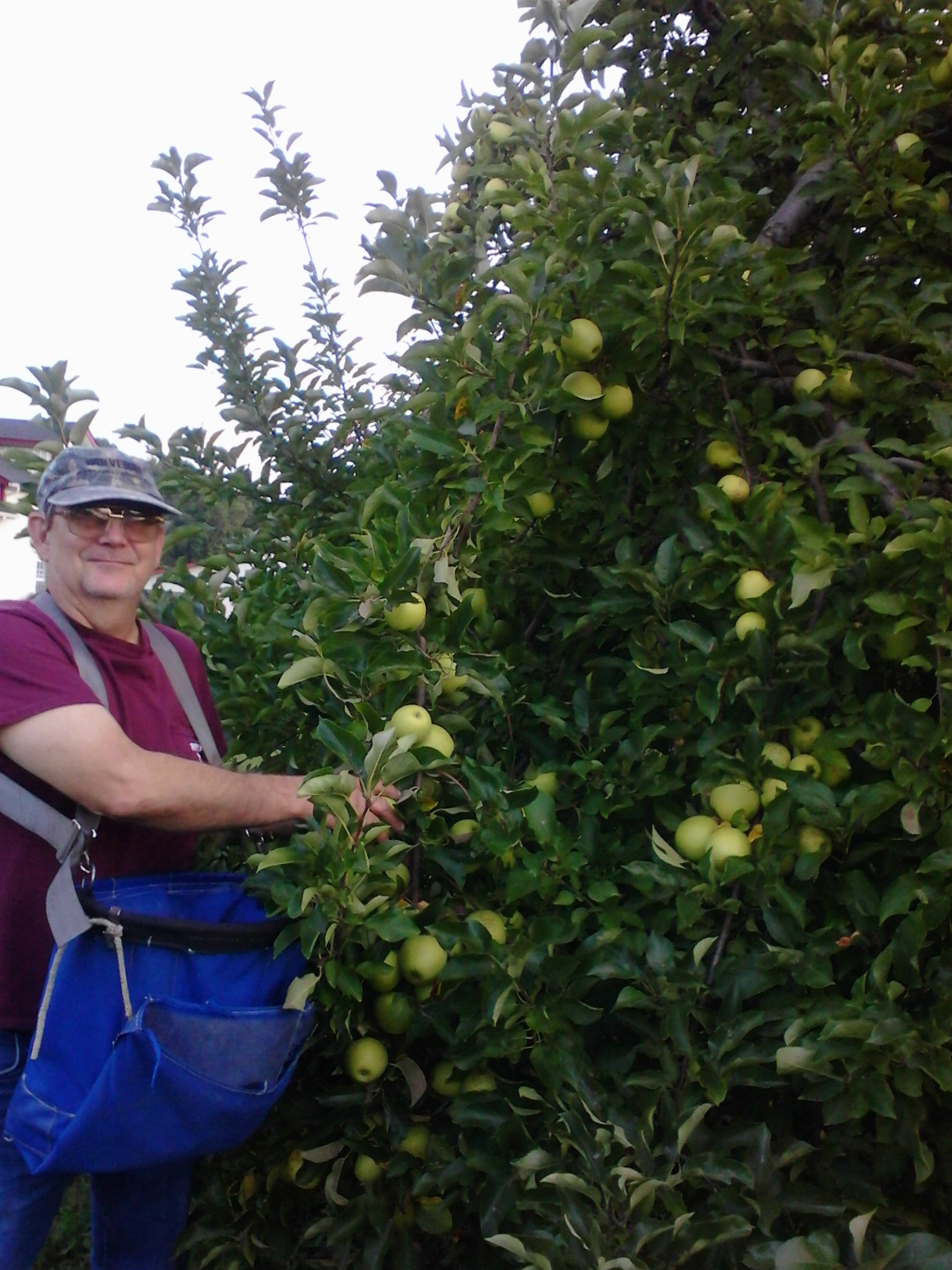
One of our friend's showing off his apple picking technique.

One of our friend’s showing off his apple picking technique.

So, what’s new at the orchard? As the waning days of August become the first days of September, we continue our efforts to harvest apples.  The Gingergold have been picked, as also the Gala.  We are finishing the McIntosh and the Honeycrisp this week.  Cortland apples are approaching their maturity as are the Empire, Yellow Delicious and soon the Red Delicious will also be ready to pick.

Continue reading

Posted in General Update | Tagged , , | Leave a comment

Eating v/s Cooking Applies

361As I explain the characteristics of our apples at market, customers often ask what qualities differentiate an “eating” apple from a “cooking” apple.  First, it is important to keep in mind that any variety of apple can be cooked and any variety of apple can be eaten fresh out of hand.  What makes the difference is the customers’ expectations.  This is the reason I always ask at market what the customer wants  the apple to do.  Do you want an apple that totally looses it shape when cooked?  Do you want an apple that cooks tender but the slices stay whole and intact?  Do you want to sauce it, make apple butter?  Do you want to dry it or make dumplings? Do you want to keep it for long term storage?  How YOU as the consumer want to use the apple should be the determining factor in choosing the variety of apple. Continue reading

Posted in Uncategorized | Tagged , , , , , | Leave a comment

2014 Market Schedule

We have determined our Market Schedule for 2014:

Wednesday:
Whites Sale Barn, Brookville, IN (Highway 52)
Rain or Shine, Daylight until sellout

Friday:
Greensburg, IN: South side of the Courthouse Square Rain or Shine, 2PM – 6PM

Saturday:
Batesville, IN: Town square
Rain or Shine: 8AM-11AM

North Vernon, IN: Town Park
Rain or Shine, 8AM-1PM

Apples are also featured by GreenBean Delivery within the Tri-State area.

Posted in Uncategorized | Tagged | Leave a comment

Summer Rains, Cool Temperatures and Delayed Harvest

Gingergold Apples have not ripened as soon as we had hoped.  Looking like we are about

'Gingergold' apples in late July. We will begin harvesting these beauties in a week.

‘Gingergold’ apples in late July. We will begin harvesting these beauties in a week.

seven days behind our usual picking schedule.  There is no need to be concerned.  This delay in harvest is due to milder temperatures experienced this season. Cooler temperatures experienced during the cell division period (spring and early summer) prolongs this stage of growth, leading to an increase in the number of divided cells within the apple. This will delay harvest, but leads to larger fruit. Milder temperatures also increase anthocyanins, which provide color to the apples.

Continue reading

Posted in Summer Orchard Management | Tagged , , , , | Leave a comment

Picking the First Apples!

Apple harvest has begun at the orchard!  This past week we have picked a small amount of Early Harvest and Lodi apples.  These two varieties are minimal in the orchard,  just one tree of Lodi and four trees of Early Harvest and thus not enough for customer sales.  However, it is the beginning of the season and in three to four weeks we will be busy picking our Ginger Gold apples.

Continue reading

Posted in General Update | Tagged , , | Leave a comment

Early June Update

May has faded into the warm days of June.  Mother Nature has blessed us with sufficient rainfalls and the storms of summer has so far evaded our area.  Threatening dark clouds and storm warnings worry those of us in the orchard business.  A beautiful crop of fruit can become less beautiful in a short time with a hailstorm.  No matter the size of the hail, the apples are now at a growth stage that any hail will cause damage to the fruit.  While the actual fruit is not damaged, hail causes “cosmetic” damage as it marks the apples with indentations.

An apple damaged by Hail. Photo sourced from: http://www.fruit.cornell.edu/tfabp/Misc/2.jpg

     Growing conditions have been very good in our region.  The grass continues to grow as do the weeds.  We continue to use the mower, weedeater and as little herbicides as we can as we maintain the orchards throughout the summer.  Applications of fungicides and insecticides continue to be an important program as the fruit puts on growth and continue to need protection.  We are starting to discover small areas of fire blight which is a bacterial infection of the branches of the trees.  We try to control this disease by pruning those infected branches and destroying them so the infection can not be spread.  Fire blight is a serious disease in an orchard and must be treated aggressively.  Passive attention to it can cause an “epidemic.”  Trees actually die from a fire blight infestation. 
 
     Every orchard has a “June drop” and we have experienced a rather heavy drop this year.  “June drop” is a shedding of fruit by the tree itself and is nature’s way of thinning.  Some factors affecting this “drop” is a lack of good pollination usually due to a shortage of bees in the orchard.  Another cause of  a larger “June” drop this year is the extremely large harvest of fruit last season.  Trees drop their load to protect themselves.  It is just part of nature and needs to be accepted as such.  Nature takes care to protect itself. 

Posted in General Update | Tagged , | Leave a comment

Apple Bloom – 2014

The bloom in the apples was breathtaking!  Cool temperatures allowed for an extended

Full bloom of an 'Anoka' apple blossom.

Full bloom of an ‘Anoka’ apple blossom.

bloom and a longer pollination period.  The severe winter affected the honey bees in our orchard.  Eighty percent of the hives did not survive the winter thus creating a need to purchase bees from outside sources.  We had always toyed with the idea to experiment with bumble bees and the need to find other “pollinators” this year made our decision rather easy.  We purchased several hives and placed them in the apple orchard.  From the first day onward, these creatures worked incessantly.  Bumble bees work under more adverse weather conditions than honey bees and we were pleasantly surprised at their work habits.  Overall, this experiment with bumble bees had “fruitful” results.
 
 Now, it is time for the agonizing decisions of thinning the varieties that are heavy in fruit set.  Thinning is done to reduce the harvest. Without it, there would be too much fruit on each tree, affecting the size of the apples.  The thinning process also helps the tree by  eliminating stress to it if the tree is heavily laden. Miscalculations  in the use of thinning chemicals could actually wipe out an apple crop.  Too much is never good in the applications of thinners.  Upon examination some varieties this year look good as they are, while others have too much fruit set.  
 
We had no blooms in the peach orchard.  Absolutely, none.  Purdue University reports a major loss in peach production throughout the state of Indiana and in our neighboring states as well.  
 
Mowing and weed control are underway in the orchards.  It’s a good thing that I like to use the mower and weed eater because both the grasses and the weeds are experiencing tremendous growth.  We make good efforts to eliminate overuse of herbicides in our orchards but in so doing, we have to use more labor intensive methods of control.   Continue reading

Posted in General Update | Tagged , , | Leave a comment

Mid-April Update: Preliminary Crop Assessment from Cold Winter

New trees arrived from the nursery on the first day of April and nothing more uplifting than tree planting.  There’s a good feeling of being one with nature when we plant the new tree stock.  Rainfall was plentiful just before the planting took place but overall conditions were conducive and now there are more trees added to the orchard.  All the plantings were apple trees.  Experimenting with a few new varieties at the request of some of our customers and also planted some “tried and true” varieties.  Some stock replaced trees that died due to disease and some were replacements for varieties that did not meet our expectations for our customers.

There will be no peaches in the orchard this season.  The winter cold devastated the fruit bud and there has not been one bloom in the orchard.  Sad when we look over and what was a burst of beautiful pink blossoms last year is now trees waiting to leaf out.  Ten degrees below zero is about the lowest temperature that our peach root stock can withstand and still have fruit bud.  This year we registered twenty to twenty-five degrees below zero for an extended period of time.  Just too cold!  It was Richard Hayden of Purdue University  that warned for every degree below minus 10 degrees a grower could expect a 10% reduction in crop production.  His warning was quite accurate this year as all fruit bud was destroyed in the prolonged cold temperatures of this past winter.

Tho weeks ago, we suffered another winter blast and had frost, freeze and nineteen degrees two nights.  Undoubtedly, there will also be some damage to the apples.  Although, more hardy than peaches, apples do not withstand that dip in temperatures without some adverse affects.  As we approach bloom we will have a more accurate appraisal of damages in the apples.

Posted in General Update | Tagged , , | Leave a comment